Compare Rayyan, ASReview and Elicit for literature screening. Evaluate reviewer workflows, evidence trails, exports and software fit.
AI Tool Finder Editorial Team · Sources checked September 12, 2026
Direct answer: choose by the review bottleneck
Shortlist Rayyan for a dedicated review workspace, ASReview for open-source screening prioritization, and Elicit for screening combined with structured extraction. The right choice depends on whether your bottleneck is coordinating decisions, ordering records for review, or extracting evidence from included papers. This is a software-selection guide, not a protocol for conducting a clinical review.
A tool that finds useful papers is not necessarily a tool that records every inclusion and exclusion decision. This comparison focuses on systematic-review screening workflows after you define the question and criteria. For general discovery and coursework, use our separate student research-tool guide.
Official website and documentation previews are vendor examples, not our test results. Cards summarise each vendor's documented workflow and the checks worth completing before buying. AIToolFinder has not run a shared test on these tools, so no comparison scores, speeds or conversion figures are shown.
We have not benchmarked these products on a common review corpus. This table does not assign sensitivity, recall or time-saving scores. Any such figure requires a defined dataset and evaluation method.
Three AI literature-screening tools compared
Rayyan: best for a dedicated review workspace
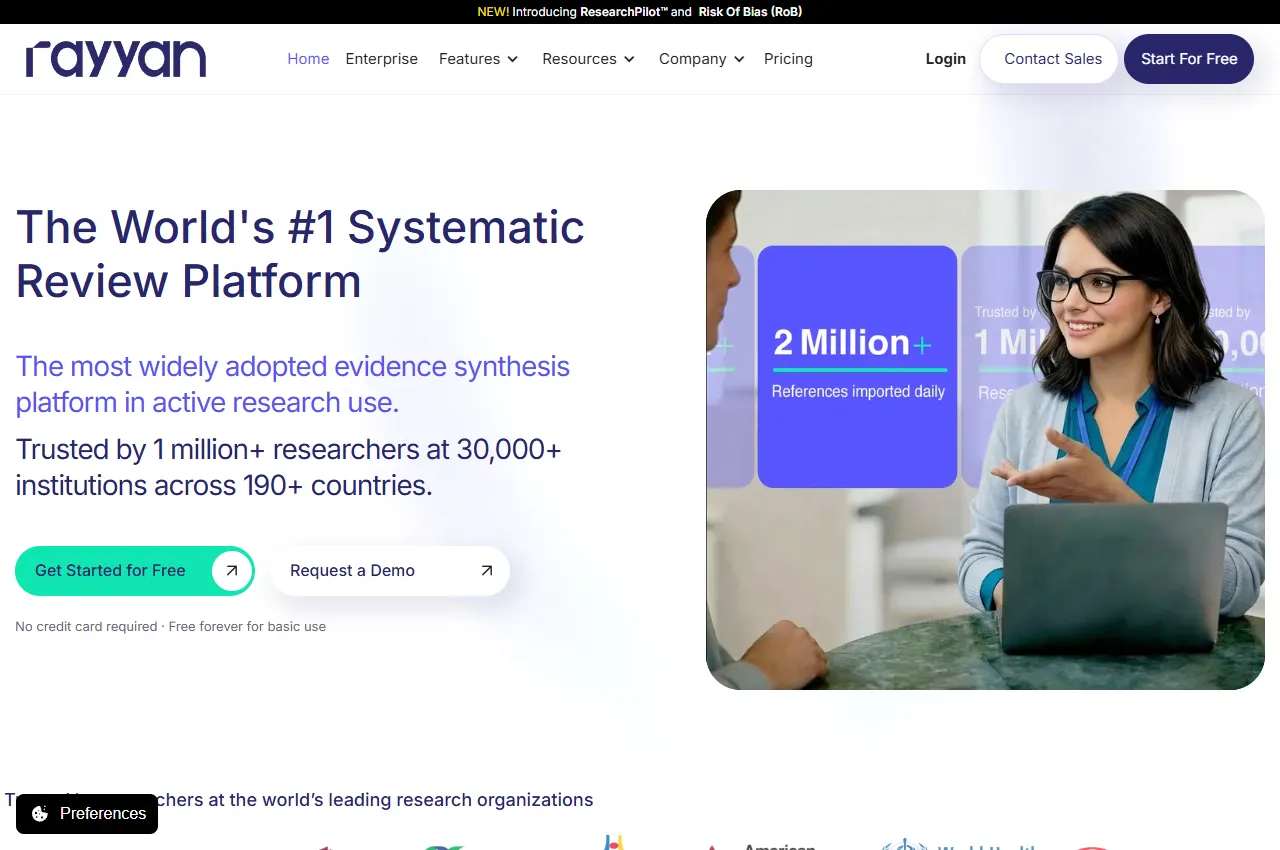
Rayyan presents a workflow covering reference organization, title-and-abstract screening, full-text screening and extraction. Its public product description includes inclusion/exclusion decisions, labels and conflict resolution. See Rayyan's platform overview and plan comparison.
Shortlist it when the problem is keeping reviewers and records coordinated. In a trial, import a small reference set and ask each reviewer to complete the same assigned process. Examine how decisions, disagreements and reasons appear in the export. The most important question is whether another team member can reconstruct what happened without reading a chat transcript.
When to skip: a full review workspace may be unnecessary for a casual reading list. Conversely, do not assume that the entry plan includes every advanced feature shown on the marketing site. Match the exact plan to the review workflow.
ASReview: best for screening prioritization with an open-source path
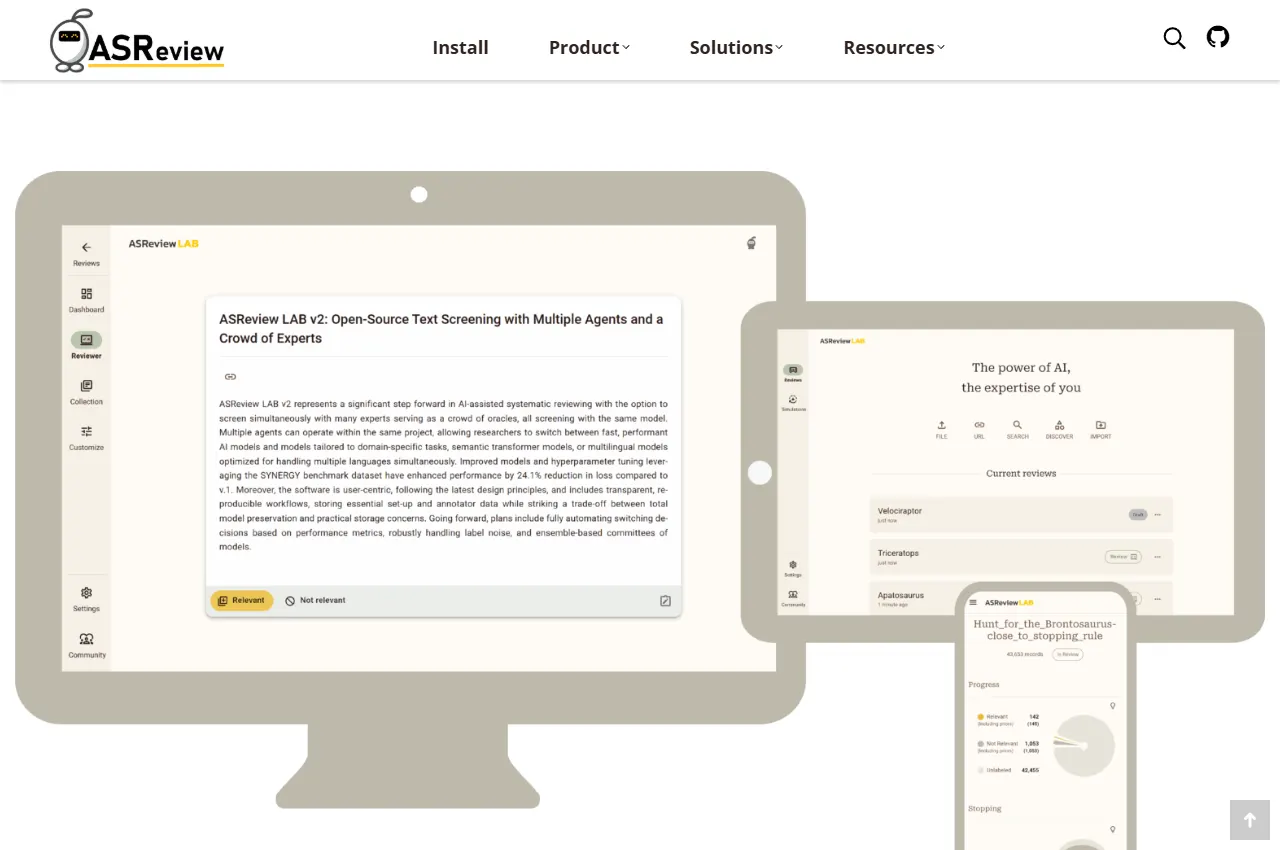
ASReview is an open-source project coordinated at Utrecht University. It provides an AI-assisted screening approach and documentation for installation and use. Its focus makes it a candidate when ordering a large set of records for human review is the main problem. Start with the official project site and documentation.
The operational choice is whether your team can own the setup and preserve the review state. Before importing the full corpus, verify that the intended operator can install the software, recover the project and export its results. Keep a record of labels and settings. Open-source availability does not remove the need for a reproducible process.
When to skip: choosing a local tool solely because it has no subscription fee is unhelpful if nobody can maintain the workflow. Also distinguish prioritization from a decision to stop screening. A useful ordering of records does not itself establish that all relevant studies have been found.
Elicit: best for connecting screening and extraction
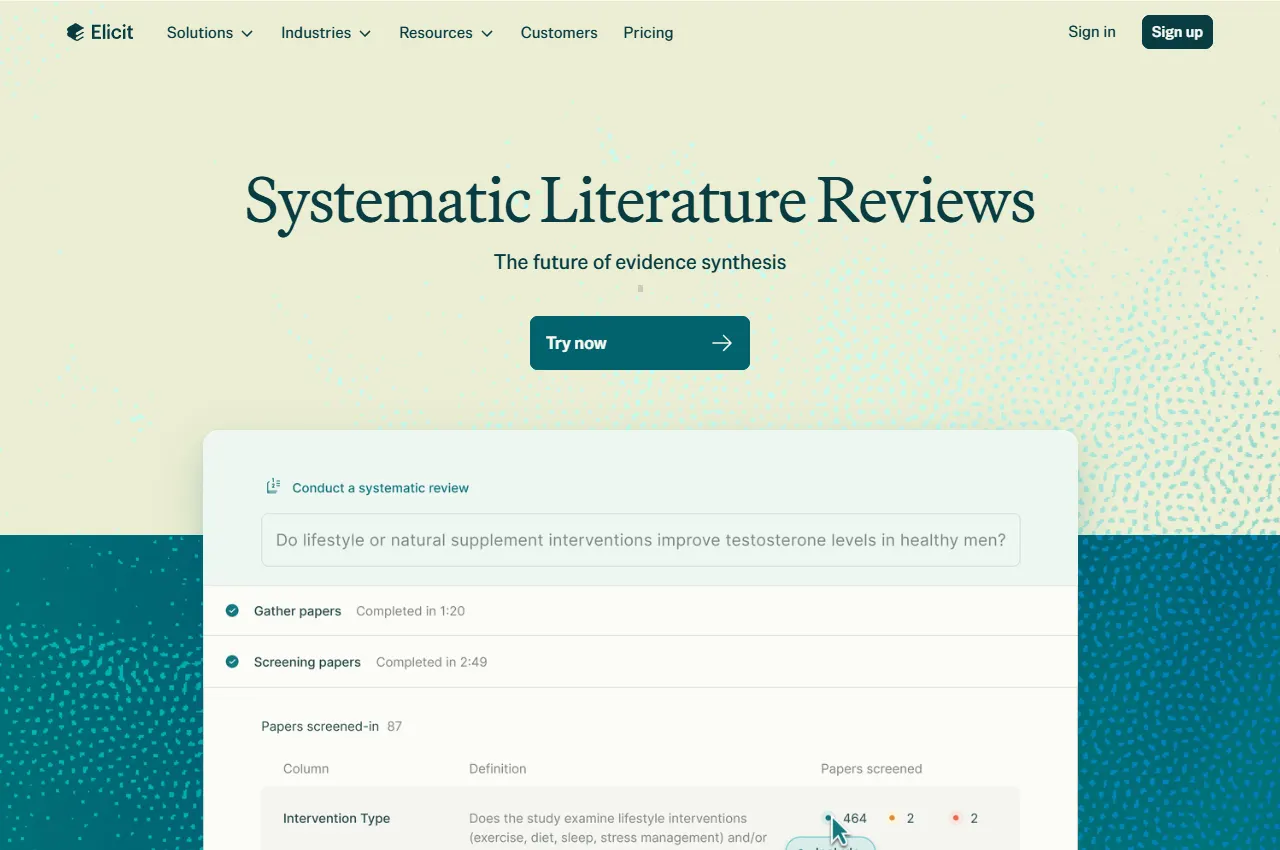
Elicit documents screening recommendations based on criteria, supporting quotations and structured data extraction. Its systematic-review workflow also includes search/import and synthesis features. That makes it a candidate when the handoff from eligibility decisions to extraction is a substantial part of the work. See the official systematic-review overview.
Trial the evidence trail, not just the generated answer. For every extracted field, open the cited passage or figure and verify the value, population and context. A correct-looking value taken from the wrong subgroup is still an extraction error. Our Elicit profile provides broader product context.
When to skip: do not choose a combined workflow if the necessary full texts are unavailable or the required decisions cannot be exported in a usable form. Confirm those requirements for your account rather than treating the presence of a citation as proof of complete source access.
How to choose without confusing search and screening
Write down which stage you are buying help with. Search retrieves candidates. Deduplication identifies repeated records. Screening applies eligibility criteria. Extraction records information from the included material. Synthesis interprets that evidence. A product may support several stages, but evidence for one stage does not demonstrate reliability in all the others.
Next, define the unit of work. Multiple papers may describe the same study, and one paper may contain several experiments. Ask how the team will represent those relationships. Otherwise, a clean-looking record list may still double-count evidence downstream.
Then define the reviewer's responsibility. Decide which decisions require a second person, how disagreements are handled, and what record must remain. Those requirements should come from the review's protocol and responsible team. Software should make them executable and visible.
A proposed screening trial with adjudicated examples
Before a large import, assemble a small set of permitted records with decisions your team has already discussed. Include clearly eligible, clearly ineligible and ambiguous examples. This is a proposed functional trial, not a statistically powered validation study or a claim about any provider's accuracy.
Freeze the criteria. Record the version used in the trial. Include enough detail to explain borderline decisions.
Check import fidelity. Compare titles, identifiers, abstracts and attachment relationships with the source export. Missing text should be visible rather than silently treated as negative evidence.
Run the planned reviewer process. Use the roles and sequence your actual review requires. Note whether software suggestions influence decisions before independent review is complete.
Inspect disagreements. Identify whether the issue is unclear criteria, missing source text or a mistaken suggestion. These require different corrections.
Export the history. Check that identifiers, decisions, reasons and reviewer information survive the export in a form the team can use.
Reopen the project. Confirm the work can be resumed and that the criteria version remains traceable.
The trial should answer whether the software supports your process. It should not be used to claim high recall across a new field from a handful of examples.
Evaluate the evidence behind a recommendation
For a screening suggestion, inspect the criterion and the supporting text separately. A paper may mention a population without actually studying that population. An abstract may omit a detail that appears in the full text. Record uncertainty explicitly so “not stated” does not quietly become “not eligible.”
For extraction, keep units, time points and denominators with the number. If a table reports both baseline and follow-up values, the export should preserve which is which. Ask the reviewer to check the original source rather than verifying one AI summary against another.
When a provider advertises an accuracy or time-saving figure, examine the evaluated task and dataset before using it in a purchasing case. A result from one review topic does not establish the same performance on your corpus. This comparison intentionally does not reuse vendor headline percentages as a ranking.
Pricing: budget the full review workflow
Rayyan publishes multiple plans; review team size and the needed feature set before selecting one. Elicit's systematic-review scope should likewise be checked against the current account and plan. This guide does not quote a historical monthly price as a current institutional offer.
ASReview provides an open-source route. That removes a particular kind of purchase barrier, but installation, training, storage and reviewer time remain real work. Compare the cost of delivering a traceable review, not just the presence or absence of a subscription.
A practical budget separates setup, screening, conflict resolution, extraction checking and export preparation. If automation reduces the first pass but creates difficult downstream verification, the apparent saving can disappear. Record time by stage during the trial instead of guessing a percentage improvement.
When to skip automated decisions
Keep a human decision when the source is incomplete, the criterion is ambiguous or the consequence of a missed record requires review under your protocol. An assistant's confidence wording is not a substitute for an agreed handling rule.
Do not stop screening simply because recent recommendations look irrelevant. A stopping decision requires an explicit method appropriate to the review and a record of how it was applied. This software shortlist does not supply that method.
For a small informal literature overview, a reference manager and a clearly labeled reading sheet may be sufficient. Use a specialized screening system when its traceability and coordination solve an actual problem.
Official product and documentation pages were checked September 12, 2026. Best-for recommendations are editorial interpretations of documented workflows. No vendor paid for a position in this shortlist, and no shared-corpus benchmark was performed.
Frequently asked questions
Which AI tool is best for systematic-review screening?
Evaluate Rayyan for a dedicated review workspace, ASReview for screening prioritization with an open-source path, and Elicit for screening connected to extraction. Match the tool to the protocol and team workflow.
Is AI literature search the same as screening?
No. Search retrieves candidate records; screening applies eligibility criteria to those records. A useful search result does not replace a traceable inclusion or exclusion decision.
Does screening prioritization tell me when to stop?
No. A stopping decision needs an explicit method appropriate to the review. The order in which a tool presents records does not by itself prove that all relevant material has been found.
What should I check in an AI extraction result?
Open the original source and verify the value, units, time point, population and supporting passage or figure. Keep uncertainty visible when the source is incomplete.
Does this guide compare recall or accuracy scores?
No. We did not run a shared-corpus benchmark. Vendor headline metrics are not used as a performance ranking, and the proposed trial is a functional workflow check.